
Uncategorized
The Complete Guide to Sustainable Packaging for Small Businesses
By Ahmad Shoukat · August 31, 2026
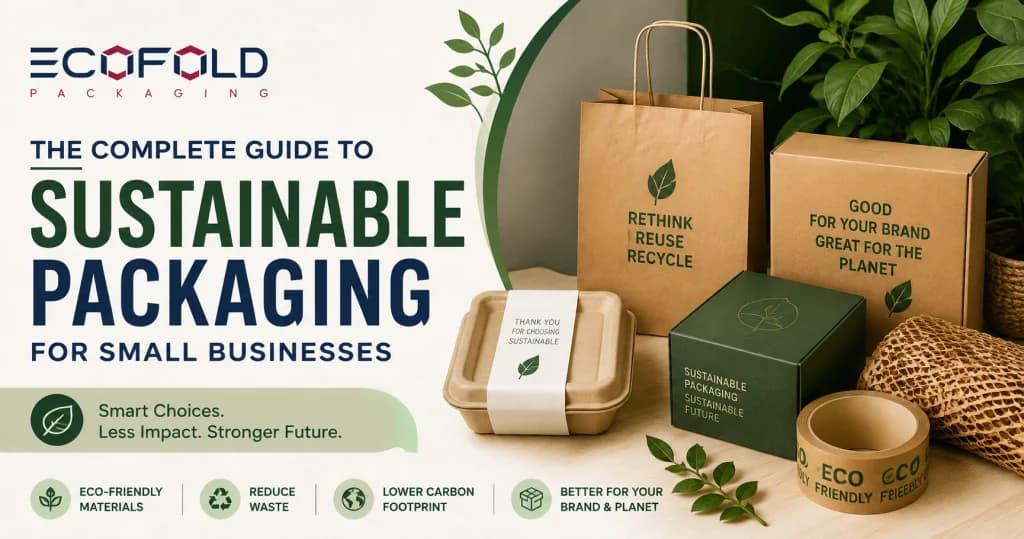
A natural food store in California now lists packaging sustainability as a standard vendor qualification criterion. An online DTC brand saw its repeat purchase rate increase after switching from a poly mailer to a branded kraft alternative.
A wholesale grocery buyer told a supplier that recyclable outer packaging was no longer optional starting the following season. These are not exceptional cases. They are the new commercial baseline for brands selling through specialty retail, natural grocery, and sustainability-aware online channels.
For small businesses, sustainable packaging has shifted from an ethical preference to a practical business requirement. This guide covers what actually matters, what it costs, what claims you can make credibly, and how to make the switch without disrupting what is working.
Why Sustainable Packaging Has Moved From Optional to Expected
Three forces are driving this shift simultaneously, and all three affect small businesses directly.
Retailer sourcing requirements are becoming explicit and measurable. Natural food stores, specialty retailers, and an increasing number of regional grocery chains assess packaging sustainability during vendor qualification. A product that cannot meet a buyer’s sourcing standards loses access to the channel before the product is evaluated on its merits.
Consumer expectations have shifted enough to affect purchase behavior. Environmentally aware consumers notice packaging materials. Repeat customers who care about sustainability reward brands that demonstrate it visibly, and they abandon brands whose packaging contradicts their values.
Extended producer responsibility legislation is advancing in California, Colorado, Maine, Oregon, and several other states. These EPR frameworks create financial accountability for plastic packaging, and brands that are already using paper-based or recyclable materials face no additional compliance cost when the regulations take effect.
Three Questions to Answer Before Choosing Any Sustainable Material
Most small businesses pick a sustainable packaging material based on cost or appearance. Both are legitimate considerations, but they come third and fourth. These three questions should come first.
What disposal infrastructure does my customer actually have access to? A certified compostable mailer shipped to a customer in a rural area without composting collection does not compost. It goes to landfill and performs no better than conventional plastic. The correct sustainable choice depends on what disposal options are realistically available at the end of the product’s journey.
What is my product requiring the packaging to do? Sustainable materials are not interchangeable with conventional ones in all applications. A kraft paper mailer works well for apparel. It fails for products that need moisture resistance in transit. A paperboard carton with an aqueous coating is curbside recyclable. The same carton with a plastic laminate is not. Product requirements determine the viable material options before any sustainability analysis begins.
What sustainability claim can I actually substantiate? Calling packaging eco-friendly without a specific qualifier is a claim that invites customer skepticism and, under FTC Green Guides, regulatory scrutiny. Claims like “made with FSC-certified board,” “recyclable at curbside,” or “certified compostable through BPI” are verifiable and defensible. “Eco-friendly” on its own is not.
Sustainable Packaging Materials Available to Small Businesses
The following materials are accessible at the order quantities most small businesses work with, typically 100 to 2,000 units per run.
| Material | Best Application | End-of-Life Claim | Cost vs Conventional |
| FSC-certified paperboard | Retail cartons, gifting | Recyclable if unlaminated | 5 to 15% premium |
| Kraft paper and kraft mailers | Ecommerce shipping, wrapping | Recyclable and biodegradable | 10 to 25% premium over poly |
| Corrugated cardboard | Shipping boxes, void fill inserts | 90%+ commercial recycling rate | Cost-neutral or lower vs foam fill |
| Recycled-content poly mailers | Soft goods where paper fails | Retail drop-off recycling | 5 to 15% premium |
| Certified compostable film | Where composting is accessible | Industrial composting (BPI certified) | 30 to 60% premium |
Brands that want to explore the full range of paper-based, FSC-certified, and recyclable carton options for retail and ecommerce can review our Custom Eco-Friendly Boxes range for the specific material and construction options available at small business quantities.
What Sustainable Packaging Certifications and Labels Actually Guarantee
The certification landscape in sustainable packaging is easy to misread. Understanding what each label covers prevents both overclaiming and underclaiming.
FSC (Forest Stewardship Council) confirms that the wood fiber in paper or board was sourced from responsibly managed forests. It is a sourcing credential, not a recyclability or compostability claim. An FSC-certified carton can still be laminated with plastic and be non-recyclable.
BPI Certification confirms a product meets ASTM D6400 for industrial composting. This is the only credible certification for compostable plastic or film in the US market. Products without BPI certification cannot make a defensible industrial compostable claim.
How2Recycle is a labeling system that communicates to consumers how each packaging component should be disposed of. It is not a sustainability certification but a consumer education tool that reduces disposal errors and supports accurate brand communication.
The distinction between certified compostable, biodegradable, and recyclable matters significantly for both product specification and marketing claims. Our blog on Compostable vs Biodegradable explains how each term is defined, tested, and verified, and why a biodegradable label without certification provides no enforceable performance guarantee.
The Brand Communication Angle Most Small Businesses Overlook
Sustainable packaging is not only a cost and compliance decision. It is a visible signal that customers read before they open the box.
For ecommerce brands, the outer packaging is the brand’s first physical touchpoint with the customer. A well-chosen sustainable outer, a printed kraft mailer, a recycled corrugated box, a paper bag with a clean die-cut window, sets the tone for the unboxing experience before any inner packaging is seen. Brands that invest in this touchpoint report stronger social sharing, higher customer review rates, and improved perception of the product itself.
For brands in natural food, beauty, personal care, and wellness, the packaging material communicates brand values before a word is read. An uncoated kraft carton with a simple two-color print sends a different signal about the brand than a gloss-laminated white box, even when both hold the same product. The surface and weight of the material are part of the communication.
Print choices for uncoated paper-based packaging follow different rules than for standard white board. Natural paper surfaces absorb ink differently, which affects color accuracy and saturation. Our guide on Packaging Colors That Sell covers how ink behaves on different packaging materials and how to choose colors that read correctly on natural and uncoated surfaces.
A Phased Roadmap That Works at Small Business Scale
Switching an entire packaging program at once is impractical for most small businesses. A three-phase approach allows each change to be absorbed before the next begins.
Phase 1 (Months 1 to 3): Replace the lowest-risk components
Void fill is the easiest starting point. Replacing bubble wrap and plastic air pillows with crinkle paper or honeycomb kraft requires no supplier change and is visible to the customer as an immediate sustainability signal. Packing tape is the second swap: water-activated kraft tape on a corrugated box allows the entire package to be recycled as one material. Inner tissue or wrap switches to uncoated or seed paper.
Phase 2 (Months 3 to 6): Evaluate the outer shipping format
Assess whether the outer shipping container can move to kraft mailers, right-sized corrugated, or recycled-content poly. This depends on the product type, the shipping route, and moisture exposure during transit. Right-sizing the corrugated box at this stage reduces both material use and dimensional weight charges from carriers.
Phase 3 (Months 6 to 12): Redesign the printed retail packaging
The printed retail carton involves the most decisions: board material, print method, finish specification, and brand artwork changes. This phase is best started after phases 1 and 2 are stable and the brand has clarity on the sustainability material that matches its product, brand position, and customer base.
Minimum order quantities play a real role in the phase timing, since sustainable materials sometimes carry higher MOQs at certain suppliers. Our guide on the Beginner’s Guide to Packaging MOQ covers how order quantity affects per-unit cost and what small businesses can do to minimize the premium at low volumes.
What Sustainable Packaging Actually Costs at Small Business Quantities
The cost premium for sustainable materials over conventional equivalents varies by material type and order quantity.
- FSC-certified paperboard over standard SBS: 5 to 15 percent, narrowing at volumes above 500 units
- Kraft mailer over standard poly mailer: 10 to 25 percent at comparable quantities
- Recycled-content poly over virgin poly: 5 to 15 percent, narrowing as recycled feedstock supply increases
- Certified compostable film over conventional plastic: 30 to 60 percent, the widest premium in the category
- Right-sized corrugated replacing oversized box plus plastic void fill: Often cost-neutral or cost-negative when dimensional weight savings are included
The right-sizing point is worth specific attention. A box sized to the product’s actual dimensions uses less board, needs less protective fill, and frequently ships at a lower carrier rate because dimensional weight pricing charges for the volume of unused space inside the package. The sustainability benefit and the cost benefit align here, which is unusual and worth taking advantage of first.
Frequently Asked Questions
What is sustainable packaging for small businesses?
Sustainable packaging for small businesses refers to packaging materials and constructions that reduce environmental impact through recyclability, responsible sourcing, recycled content, or compostability, chosen at the order quantities and per-unit costs that are practical for brands ordering between 100 and 5,000 units per run.
Which sustainable packaging materials are most accessible for small businesses?
FSC-certified or recycled paperboard, kraft paper and kraft mailers, paper void fill, water-activated kraft tape, and recycled-content poly mailers are the most widely available options at small order quantities. Certified compostable films are available but carry the highest cost premium.
Is sustainable packaging more expensive for small businesses?
Generally 5 to 60 percent more per unit depending on the material. Paper-based replacements for plastic sit at the lower end of that range. Right-sizing packaging is the change that can reduce costs rather than increase them, through lower material use and better carrier dimensional weight rates.
How do I make a credible sustainability claim about my packaging?
Use specific, certification-backed claims. “Made with FSC-certified paper,” “certified compostable by BPI to ASTM D6400,” or “100 percent recyclable at curbside” are verifiable. “Eco-friendly” or “green packaging” without a specific qualifier are not substantiable under FTC Green Guides and should be avoided.
Where should a small business start when switching to sustainable packaging?
With the lowest-risk, lowest-cost components: void fill, packing tape, and inner wrap. These are fast to switch, visible to the customer, and require no supplier change or artwork revision. Outer shipping formats come next, and printed retail cartons are redesigned last.