
Guides
The Beginner’s Guide to MOQ: Why Packaging Minimums Matter
By editoruser · July 30, 2026
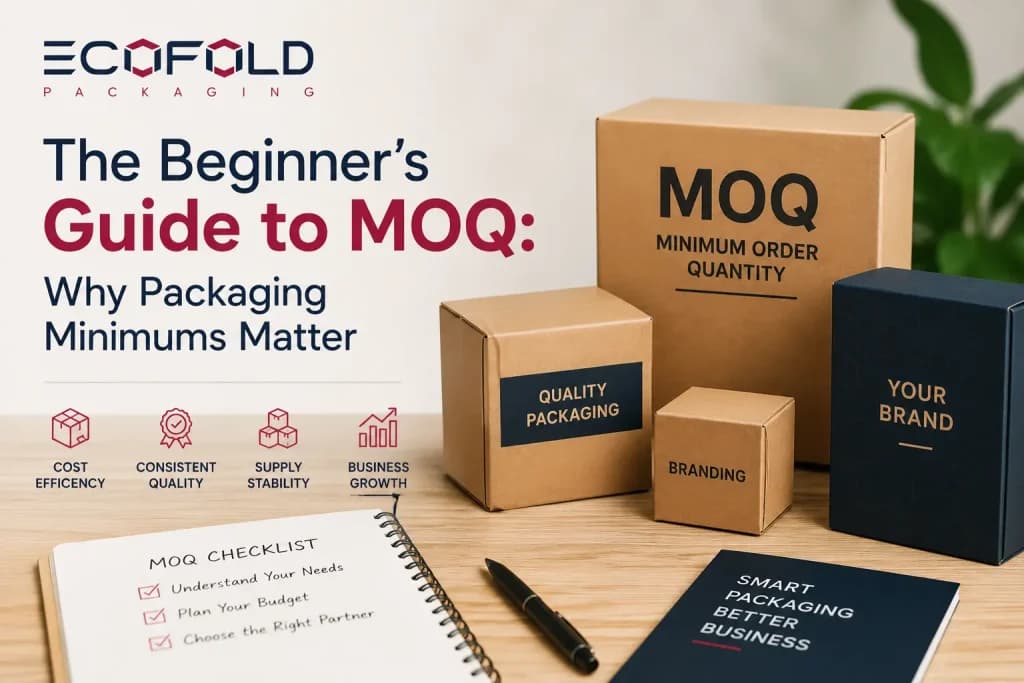
Most small brands run into their first MOQ when they request a quote for custom packaging and discover the minimum is 500 boxes. They need 50. The number feels arbitrary. It is not.
Packaging MOQ stands for Minimum Order Quantity, the smallest number of units a supplier will produce in a single production run. Understanding why that number exists, how it affects cost, and what options exist below it is one of the more useful pieces of knowledge a brand can have before placing their first custom packaging order.
What MOQ Actually Means in Custom Packaging
The minimum order quantity is not a preference or a sales tactic. It is an economic threshold built directly into how packaging production works. Every custom packaging job involves a set of fixed costs that occur before a single finished unit comes off the line: setting up the die, preparing printing plates, calibrating the press, running test sheets, and adjusting color registration. Those costs stay roughly constant whether the order is 50 units or 5,000.
Below a certain quantity, a supplier cannot spread those fixed costs across enough units to price the job at a margin that covers the business. The minimum order quantity packaging threshold is the point at which the economics work for both the supplier and the buyer. Every unit above the MOQ dilutes those fixed costs further and brings the per-unit price down.
Why Packaging Manufacturers Set a Minimum
Four specific cost drivers push MOQ up on custom packaging runs:
Machine setup time. Printing presses and die-cutting lines must be configured for every new job. That configuration takes time, materials, and skilled labor that do not scale proportionally with smaller quantities.
Printing plates. Offset printing requires physical plates produced for each ink color in the design. Plate production is a fixed upfront cost. An order of 100 units carries the same plate cost as an order of 1,000, but the plate cost represents a much smaller share of revenue on the larger run.
Material minimums. Paperboard, kraft, and specialty stocks are purchased from mills in sheets or rolls with their own minimum quantities. A very small custom box order may require the supplier to buy more material than the job uses, and that waste is priced into the unit cost.
Production throughput. A short run occupies equipment that could be running a larger, more efficient job. Suppliers structure their capacity around MOQs that keep production lines moving at a pace that supports the business.
How MOQ Affects What You Pay Per Box
The relationship between quantity and per-unit cost is not linear. A custom box that costs $1.50 per unit at 100 units might cost $0.85 at 500 units and $0.55 at 2,000 units. The sharpest drop in cost happens between the MOQ and roughly three to five times the MOQ.
After that, the savings per additional unit become smaller as fixed costs have already diluted significantly and variable costs start to dominate.
This is why supplier quotes show tiered pricing. The first price column is typically the MOQ. Each subsequent column represents a quantity break where the per-unit cost drops because fixed costs have diluted further. Brands that understand this structure can make more informed decisions about how many units to order and when.
Our guide on the Real Cost of Custom Packaging covers how material choice, box structure, print options, finish, and quantity interact to produce the final quote.
What Determines the MOQ for Your Specific Order
Not all packaging has the same MOQ. The minimum for a specific order depends on the job’s cost profile:
- Printing method. Digital printing requires no physical plates and has low setup costs. This allows MOQs of 50 to 100 units. Offset printing requires plate preparation and typically has MOQs of 500 units or above.
- Box structure complexity. A simple tuck-end carton using a standard die costs less to set up than a custom rigid box with embossing, foil, and a magnetic closure. Complex construction pushes MOQ up.
- Material type. Standard SBS cardstock has lower material minimums at the mill level than specialty boards, coated substrates, or natural fiber papers.
- Finish options. Each additional finish, whether lamination, foil stamping, or spot UV, adds a production step with its own setup cost. More finishes generally raise the MOQ.
For brands considering sustainable materials as part of the specification, our guide on What Makes Packaging Truly Eco-Friendly explains which material and finish combinations support recyclability claims and which do not.
Low MOQ Packaging Options for Startups and Small Brands
Getting branded custom packaging at lower quantities is possible, but the right approach depends on what trade-offs a brand is willing to accept.
Choose digital printing. No plates means no plate setup cost, which removes the largest driver of high MOQs. Most digital packaging programs start at 50 to 100 units.
Use standard structures. A standard tuck-end or auto-bottom carton with an existing die in the supplier’s inventory requires no custom die setup. This eliminates another fixed cost.
Simplify the finish specification. A clean one-color logo on white cardstock with no laminate has a much lower production cost structure than a six-color design with soft-touch and embossing. Simplifying the spec makes lower quantities viable.
For brands also looking at eco-positioned material options that work at lower quantities, our Custom Eco Friendly Boxes in USA range includes kraft and recyclable paper-based packaging formats that are available at lower minimum quantities and suit natural or sustainability-focused brands.
The Calculation Most Brands Skip
Ordering at a quantity above MOQ to get a lower per-unit price only makes sense if the full cost picture is favorable. A brand that orders 5,000 boxes at $0.40 each instead of 500 at $0.80 each saves $2,000 on a per-unit basis but commits $2,000 more upfront and needs warehouse space for 4,500 additional boxes.
If the design changes before those boxes are used, which happens regularly with growing brands, the savings disappear.
New brands especially should be careful about ordering significantly above MOQ before their packaging has been tested in the market. Visual identity evolves. Product specifications change. Retailer feedback sometimes requires label revisions. Ordering closer to MOQ on early runs keeps those costs manageable.
The Practical Takeaway
MOQ is not an obstacle put in place by suppliers to exclude small buyers. It is a reflection of how production costs are structured. Understanding the mechanics behind it makes conversations with suppliers more productive and helps brands ask the right questions: What is the printing method? Is a standard die available? What happens to the per-unit cost at 250, 500, and 1,000 units?
Brands ready to explore packaging options and request a quote across formats, materials, and print specifications can find the full range at Custom Packaging Boxes on EcoFold’s site.
Frequently Asked Questions
What does MOQ mean in custom packaging?
MOQ stands for Minimum Order Quantity, the smallest number of units a supplier will produce in a single run. In custom packaging, it typically ranges from 50 to 500 units depending on the box type, printing method, and production complexity.
Why do packaging manufacturers require minimum order quantities?
Because every custom packaging job involves fixed setup costs (dies, printing plates, machine calibration) that must be spread across enough units to make the job economically viable. Below the MOQ, those fixed costs cannot be recovered at a price the buyer would accept.
Can startups order low MOQ custom packaging?
Yes. Digital printing, standard box structures, and simplified finish specifications all reduce setup costs and enable lower MOQs. Some suppliers offer MOQs as low as 50 to 100 units on digitally printed packaging.
How does MOQ affect packaging costs?
Higher quantities spread fixed setup costs across more units, reducing the per-unit price. The biggest per-unit savings happen between the MOQ and roughly three to five times the MOQ. After that point, additional savings per unit become smaller.
What factors determine the MOQ for custom packaging?
Printing method (digital vs. offset), box structure complexity, material type, and the number of finishing steps all affect MOQ. Simpler specs on standard structures with digital printing tend to have the lowest minimum quantities.