
Guides
Custom Packaging Cost in 2026: What Brands Miss
By Ahmad Shoukat · July 8, 2026
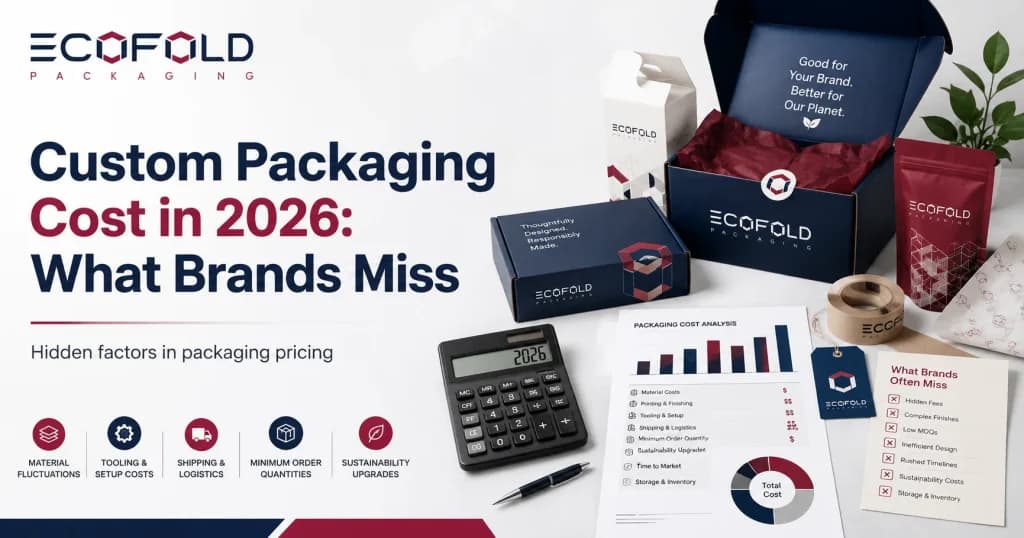
Most brands ask one question before ordering packaging: how much per box? It is a reasonable place to start and almost always an incomplete picture. Custom packaging pricing is shaped by far more than dimensions alone.
Two boxes of identical size can have very different costs depending on the board type, printing, finishes, structure, and quantity ordered.
Understanding what drives each element helps brands build more accurate budgets, avoid surprises after the first invoice, and make better decisions before committing to production.
Material Sets the Starting Point
The base material determines the cost floor before printing or finishing is considered. Unbleached kraft paperboard is one of the most cost-accessible paper-based options and prints well for retail, artisan, and food packaging applications.
SBS white paperboard supports sharper print detail and most surface finishes at a moderate cost step up. Corrugated board adds cost through its three-layer construction but delivers the structural performance that shipping and heavier products require.
Rigid chipboard for premium two-piece gift and product boxes sits at the highest cost point because of the board thickness, the separate wrap paper, and additional manufacturing steps.
Brands deciding between material types based on product weight and distribution should read our comparison guide on Kraft vs Corrugated Boxes. For retail, artisan, and lightweight food packaging applications, kraft boxes are a practical and cost-effective starting point for most brands.
Size and Product Fit Affect the Quote
Larger boxes consume more material. A box that is oversized for the product inside increases the board area in the dieline, adds shipping weight, and often requires more cushioning inside to prevent movement.
Right-sizing packaging to the product dimensions reduces the per-unit material cost. For brands ordering in volume, even a modest reduction across the length, width, or height of the box compounds into meaningful savings at the end of a production run.
Printing Changes the Price at Every Level
An unprinted box is always the cheapest version of that specification. A single-color logo adds a small cost step. Full CMYK across all exterior panels adds more. Inside printing adds a second press pass.
The number of colors, the ink coverage area, and the number of panels printed all contribute to the final custom box cost. Brands that concentrate print on the front and back panels manage cost without losing brand visibility across the product.
Finishes Add Cost One Step at a Time
Each finish is a separate production step with its own setup and application cost. Matte or gloss lamination adds a modest cost but significantly changes how the box reads in the hand. Soft-touch matte is higher still. Foil stamping, embossing, debossing, and spot UV each carry setup costs on top of base print.
Window die-cuts add a cutting step and often a clear film material. Stacking several finishes on a single box multiplies the cost at each stage, which is why premium packaging can cost two to three times a basic equivalent with the same dimensions.
Box Structure Has Its Own Pricing Logic
A flat tuck-end folding carton is the simplest and most cost-effective folding structure. Auto-bottom boxes require pre-gluing at the factory, which adds a production step. Tube packaging uses a different winding process. Display boxes with opening mechanisms add complexity.
Rigid two-piece boxes for premium products have the highest structural cost because they require thicker chipboard, a separate wrap paper, and more assembly stages. Custom Rigid Boxes reflect all of those production needs in their pricing, which is why they sit meaningfully above standard folding carton cost on any comparable quote.
Order Quantity Directly Affects Per-Unit Cost
Setup costs — dieline tooling, press configuration, and plate preparation — are spread across every unit in the production run. At 100 units, setup represents a larger share of each box’s price. At 500 or 1,000 units, the same setup cost is spread across more units and the per-unit price drops.
Corrugated Boxes and folding cartons follow this pattern. Most EcoFold orders begin at a minimum order quantity of 100 units. Brands should balance bulk pricing against storage space, cash flow, and the likelihood of design changes before committing to very large quantities on a first run.
Inserts, Labels and Printed Extras Add to the Total
A packaging quote for the box itself does not always include everything a product needs to be shelf-ready or ecommerce-ready. A foam or cardboard insert that holds the product securely inside the box is a separate item. Adhesive product labels, tamper-evident seals, and compliance stickers add cost when ordered as part of a packaging program.
Custom Packaging Inserts for fragile or multi-item products are consistently among the most overlooked cost additions brands encounter after an initial box quote. Budget for the full packaging system, not just the outer box.
Turnaround and Revision Cycles Matter
A standard production timeline of 8 to 10 business days runs from artwork approval, not from order placement. Expedited production carries a premium.
Artwork revisions that require structural changes to the dieline after the initial approval add time and in some cases restart the production schedule.
Brands with final, press-ready artwork files in the correct format move through production faster and avoid the revision costs that can push a budget beyond the original quote.
What To Have Ready Before Requesting a Quote
A custom packaging quote becomes more accurate when the brand provides specific inputs at the start. Before requesting a quote, have ready:
- Product dimensions and weight
- Intended order quantity
- Material preference (kraft, SBS, corrugated, rigid)
- Printing requirements (one-color, full CMYK, inside or outside only)
- Finish preference (none, matte, foil, spot UV)
- Insert or structural needs
- Delivery location and required timeline
- Artwork status (final files or still in progress)
Brands that provide these details upfront receive faster and more accurate quotes. For a full view of custom packaging options by product type, industry, and box style, Custom Packaging Boxes in USA covers the range across retail, ecommerce, food, cosmetics, and specialty product lines.
The Bottom Line on Custom Packaging Cost
The cheapest box is not always the right box. Packaging that does not protect the product causes damage and replacements. Packaging that does not present the product well loses shelf appeal.
The goal is a box that fits the product, suits the brand, and does not cost more than the application justifies. Understanding the packaging cost factors behind a quote makes that decision clearer before production begins.
Frequently Asked Questions
What affects the cost of custom packaging?
Material, box structure, print coverage, finishes, order quantity, inserts, and turnaround time all affect pricing. Two boxes with the same dimensions can cost differently if the board type, finish, or structure differs.
Does order quantity change custom packaging pricing?
Yes. Setup costs are spread across units in the run, so larger quantities reduce the per-unit cost. Most custom packaging programs begin at a minimum order quantity of 100 units.
Are rigid boxes more expensive than kraft or corrugated boxes?
Yes. Rigid boxes use thicker chipboard, a separate wrap paper, and require more assembly steps than standard folding cartons. That additional production cost is reflected in the per-unit price.
Do printing and finishing options increase packaging cost?
Yes. Each print pass, surface finish, and production step adds cost. Full CMYK with foil stamping and soft-touch lamination costs more than a single-color print with no finish on the same box.
How can I get a more accurate custom packaging quote?
Provide product dimensions, weight, order quantity, material preference, print requirements, finish needs, insert requirements, delivery location, and artwork status when requesting a quote.