
Guides
Compostable vs Biodegradable: What’s the Real Difference?
By editoruser · August 24, 2026
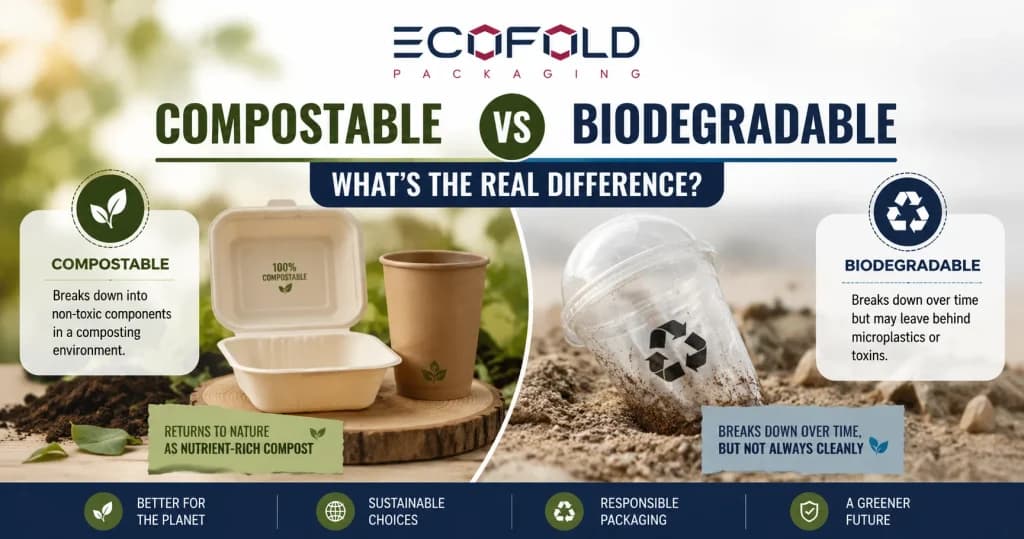
The two words appear side by side on packaging labels, in brand sustainability statements, and in retail buyer sourcing requirements. Compostable and biodegradable look interchangeable until you start asking specific questions. Where does this material break down? How long does it take? Under what conditions?
At that point, the two terms diverge significantly, and the difference matters for brands making packaging decisions, for customers trying to dispose responsibly, and for the credibility of any sustainability claim built around these words.
What Biodegradable Actually Means
Biodegradable describes a material’s capacity to be broken down by microorganisms, including bacteria, fungi, and other biological agents, into natural substances such as water, carbon dioxide, and organic matter. The definition is intentionally broad. Almost any organic material is biodegradable given sufficient time and the right conditions.
The practical problem is that biodegradable as a product label carries no regulated timeframe and no specified conditions in the United States. The FTC Green Guides (Section 260.8) address biodegradable marketing claims, but enforcement is limited and the standards are vague. A product can carry a biodegradable label even if it will take decades to break down in a landfill under current disposal conditions.
This does not make biodegradable materials without value. It means the claim alone, without further qualification, communicates less than most consumers assume.
For brands comparing which specific materials are replacing conventional plastic, our guide on 5 Sustainable Materials Replacing Plastic Packaging covers how each material performs across recyclability, compostability, and biodegradation scenarios.
What Compostable Actually Means
Compostable is a more specific and more defensible term. A compostable material is one that biodegrades under defined conditions (controlled temperature, moisture, and microbial activity) within a defined timeframe, leaving behind no harmful residue.
In the United States, the primary standard for compostable packaging is ASTM D6400. It requires that a material disintegrate within 12 weeks, biodegrade at least 90 percent within 180 days in a controlled industrial composting environment, and leave behind no toxic residue and no more than 10 percent of material remaining.
Products that meet this standard and receive third-party certification from the Biodegradable Products Institute (BPI) can carry a verified compostable claim.
Compostable claims on packaging without certification to this or an equivalent standard are not verifiable by any independent measure.
The Core Difference: Conditions and Timeframe
Key point: All compostable materials are biodegradable, but not all biodegradable materials are compostable. Compostable requires specific conditions and a defined timeframe. Biodegradable requires neither.
A banana peel is both biodegradable and compostable. A product marketed as biodegradable without further qualification may break down eventually but cannot break down within the timeframe and conditions a composting standard requires.
This is not a minor distinction in the context of packaging claims. It determines what responsibility the brand is placing on the customer’s disposal behavior and whether any environmental benefit actually results.
Industrial Composting vs Home Composting: The Missing Distinction
Most brands and consumers who do understand compostability miss this second layer, and it is the most practically important one.
Industrial composting (also called commercial composting) occurs at managed facilities operating at sustained temperatures of 55 to 60 degrees Celsius with controlled moisture and regular turning to introduce oxygen.
These conditions drive rapid and thorough microbial activity. Most compostable bioplastics, including PLA (polylactic acid from corn starch) and PBAT, are certified to ASTM D6400 and break down within 90 to 180 days under these industrial conditions.
Home composting operates at lower temperatures (25 to 50 degrees Celsius), slower turnover, and variable moisture. PLA bags, cups, and containers will not break down in a home compost bin within any practical timeframe under these conditions. A PLA-based bag placed in a home compost pile will remain largely intact for a year or more.
Paper-based and natural fiber compostable packaging generally breaks down in both industrial and home composting conditions. When a brand specifies compostable packaging, the type of composting the certification covers must be stated. Industrial and home compostable are not interchangeable, and in many US cities, industrial composting pickup is limited or unavailable.
Why Some Biodegradable Claims Mislead
Two specific product categories carry biodegradable claims that warrant close examination.
Oxo-degradable plastics are conventional plastics with chemical additives that cause the material to fragment into smaller pieces when exposed to heat or UV light. The result is microplastic particles, not genuine biodegradation. The European Union banned oxo-degradable packaging in 2021 as part of the Single-Use Plastics Directive. In the United States, these products can still legally carry biodegradable claims on labels.
Plant-based plastics offer a similar gap between perception and reality. A bioplastic made from corn starch or sugarcane is produced from renewable resources, but without industrial composting conditions, it behaves in a landfill almost identically to petroleum-based plastic. The renewable origin of the feedstock does not change the end-of-life behavior of the material.
What Neither Term Guarantees in a Landfill
This is the most counterintuitive and most practically important point in this comparison.
Modern landfills are engineered to isolate waste from the surrounding environment. They restrict oxygen, limit moisture, and minimize microbial activity to prevent contamination of surrounding soil and groundwater. These are precisely the conditions that slow or prevent biodegradation and make composting impossible.
A certified compostable bag sent to a landfill will not break down meaningfully. A biodegradable product in a landfill will not break down meaningfully. This is not a failure of the material. It is a consequence of landfill engineering.
For either claim to deliver environmental benefit, the packaging must be diverted to the appropriate processing stream, composting for compostable materials and recycling for recyclable ones, rather than ending in landfill.
Certifications That Make Claims Verifiable
For brands that need compostability claims to be credible and defensible, three certifications are the most relevant in US and global markets.
- BPI (Biodegradable Products Institute) certification: Third-party testing confirming the product meets ASTM D6400 (compostable packaging) or ASTM D6868 (compostable coatings on paper substrates). The most recognized industrial compostable certification in the United States.
- OK Compost Home (TUV Austria): Certification that a product breaks down in home composting conditions, a more demanding standard than ASTM D6400 because it requires breakdown at lower temperatures without controlled aeration.
- Seedling logo (EN 13432): European industrial composting standard. Commonly seen on packaging sold globally; indicates conformance with the EU’s industrial composting requirements.
For brands building broader sustainable packaging programs and evaluating how these certifications fit into material and finish decisions, our guide on What Makes Packaging Truly Eco-Friendly covers how material choice, coating type, and certification interact across different packaging formats.
Which Is the Right Choice for a Packaging Program?
Neither term is inherently better. The right choice depends entirely on what end-of-life infrastructure the end customer has access to.
If customers have curbside recycling but no composting access, recyclable packaging is more likely to reach its intended end of life than certified compostable packaging that requires a composting facility. If the customer base is in an area with municipal composting pickup, certified industrial compostable packaging makes sense.
If the disposal path is uncertain, paper-based packaging that is recyclable, compostable, and biodegradable covers more end-of-life routes than a single certified compostable option.
Brands building a sustainable packaging program for the first time can find material and format options across our Custom Eco-Friendly Boxes range, including kraft, FSC-certified, and recyclable paper-based options. For practical guidance on where to start, our guide on Sustainable Packaging for Small Businesses covers the phased approach that works for most small to mid-sized brands.
Frequently Asked Questions
What is the difference between compostable and biodegradable?
Biodegradable means a material can be broken down by microorganisms, with no defined timeframe or conditions required. Compostable means a material breaks down within a defined timeframe (typically 90 to 180 days) under specific temperature, moisture, and microbial conditions, leaving no harmful residue.
Does compostable packaging break down in a home compost bin?
Depends on the material. Paper-based and natural fiber compostable packaging generally breaks down in home composting conditions.
Does biodegradable or compostable packaging break down in a landfill?
No. Landfills restrict oxygen and moisture to prevent environmental contamination, which are the conditions required for both biodegradation and composting.
What certifications should I look for in compostable packaging?
BPI certification for industrial compostable materials meeting ASTM D6400, OK Compost Home certification for home compostable materials, and the Seedling logo for packaging certified to the European EN 13432 industrial composting standard.
Is plant-based plastic the same as compostable?
Not automatically. Plant-based plastic is made from renewable feedstocks such as corn or sugarcane, but without industrial composting conditions it behaves in the environment similarly to petroleum-based plastic.