
Guides
5 Sustainable Materials Replacing Plastic Packaging in 2026
By Ahmad Shoukat · July 22, 2026
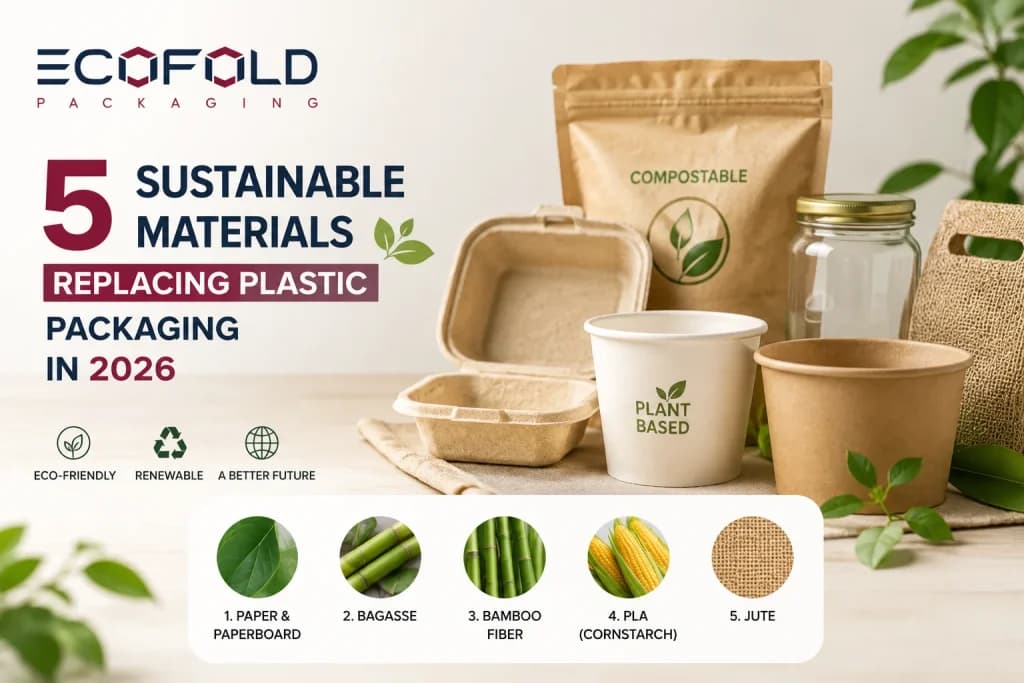
The case for switching away from plastic packaging has shifted considerably over the past few years. It is no longer driven purely by brand values or consumer pressure.
Better material availability, improved processing infrastructure, retailer sourcing requirements, and extended producer responsibility legislation across several US states have made plastic harder to justify as the default choice.
These five materials are the most significant replacements for plastic packaging in 2026, covering what each one is, where it performs well, and what brands should understand before committing to a switch.
Kraft Paper and Paper-Based Packaging
Kraft paper is produced through a pulping process that gives the material more natural fiber strength than standard paper. It biodegrades in most environments and is accepted in standard paper recycling across most US markets. These properties, combined with improving product performance, have made it the most widely adopted plastic replacement in ecommerce, retail, and food packaging.
Paper-based formats now cover most of the applications where flexible plastic was the only practical option a few years ago. Honeycomb wrap replaces bubble wrap for void fill. Paper mailer bags replace poly bags for ecommerce shipping.
Paper-based pouches replace plastic stand-up pouches for food and supplements. The key condition for maintaining recyclability is avoiding plastic lamination. Aqueous coatings are generally compatible with paper recycling streams, while bonded plastic films are not.
Retail brands building a paper-based packaging program can explore Kraft Boxes for the standard carton and sleeve formats available in kraft paper and board.
Corrugated Cardboard Replacing Plastic Foam
Corrugated cardboard is not a new material, but its use as a direct replacement for plastic protective packaging is one of the more significant format shifts happening at scale right now.
Polystyrene foam inserts, bubble wrap, and plastic air pillows have all been the standard for cushioning and void fill for decades. All three are now being replaced by die-cut corrugated inserts, molded cardboard trays, and crinkle paper in many product categories.
Corrugated board consistently achieves commercial recycling recovery rates above 90 percent in the United States. A well-designed die-cut corrugated insert provides comparable protection to foam for most product types.
The fluted inner core absorbs and distributes impact energy the same way foam does, without the recycling and waste complications that plastic foam creates. Corrugated Boxes in single-wall, double-wall, and heavy-duty grades cover most protective applications where brands are eliminating plastic foam.
Compostable Packaging Materials
Compostable packaging covers a family of materials including PLA (polylactic acid from corn starch), PBAT (polybutylene adipate terephthalate), thermoplastic starch, and related plant-based polymers. These materials are designed to break down into organic matter within a defined timeframe when processed under the right conditions.
The most important distinction for brands and buyers: most compostable packaging requires industrial composting to break down properly. A PLA bag marked as compostable will not degrade in a landfill. It will not degrade in a home compost bin within any practical timeframe. Industrial composting facilities provide specific temperature, moisture, and microbial conditions that the material needs to complete its breakdown cycle.
Third-party certification from the Biodegradable Products Institute (BPI) confirms that a product meets ASTM D6400, the US standard for industrial compostable materials. Brands using compostable packaging as part of a sustainability claim should confirm that their primary markets have industrial composting access before building that claim into marketing materials.
For a detailed breakdown of how composting, biodegradation, and recycling actually differ, our guide on What Makes Packaging Truly Eco-Friendly covers each term in specific, practical terms.
Mycelium Packaging
Mycelium packaging is grown from a combination of agricultural waste, typically corn husks, hemp stalk, or rice hulls, and mycelium, the root-like structure of fungi. The mixture grows inside a shaped mold over several days and produces a rigid, lightweight material that performs comparably to expanded polystyrene foam in cushioning and compressive strength.
After use, mycelium packaging breaks down in home compost in approximately 30 to 90 days without leaving harmful residue. The energy required to produce it is substantially lower than petroleum-based foam manufacturing. Most current commercial use is in high-value protective packaging for electronics, luxury goods, wine, and precision equipment, where the higher per-unit cost is more easily absorbed at the product price point.
The practical limitation worth stating clearly: mycelium packaging is not yet cost-competitive with commodity polystyrene foam at high production volumes. Cost parity is improving as the technology scales, but it is not the right choice for most general-purpose packaging programs in 2026 based on cost alone.
Seaweed and Plant-Based Flexible Films
Seaweed-based packaging materials are derived from macroalgae, which requires no freshwater, no fertilizer, and no arable land to grow. Those growing conditions make macroalgae significantly less resource-intensive than most land-based crop materials. Processed into flexible films, seaweed material is used for sachets, pouches, and single-use packaging in food service and consumer products. Some versions are edible. Others are designed to dissolve in water or compost within weeks.
Plant-based flexible films from other sources, including cellulose, cassava starch, and agricultural fiber, are also replacing single-use plastic films in cosmetic, food, and ecommerce packaging applications. Barrier properties and durability are still more limited than conventional plastic in many applications, but material performance is improving as processing technology develops.
Brands evaluating sustainable packaging materials for retail and product packaging can explore Custom Eco-Friendly Boxes for the full range of paper-based and recyclable options available for retail, ecommerce, and specialty product packaging.
How to Choose the Right Material for Your Product
The switch from plastic to a sustainable alternative is rarely a straightforward swap. The right material depends on what the packaging needs to accomplish: protect the product through a specific shipping environment, satisfy a retailer’s sourcing requirements, communicate the brand at the point of sale, and be properly disposed of by the end consumer.
Some sustainable materials perform better than plastic in certain situations and worse in others. A paper mailer handles most standard shipping conditions well but fails in wet environments. A compostable film meets a sustainability target on paper but does nothing useful if the customer has no industrial composting access nearby. The material choice that actually reduces environmental impact is the one matched to the product’s full journey, not just the one that sounds most sustainable on the packaging.
EcoFold Packaging offers Custom Packaging Boxes across kraft, corrugated, and paper-based materials for retail, ecommerce, and specialty product programs.
Frequently Asked Questions
What are the best alternatives to plastic packaging?
Kraft paper, corrugated cardboard, compostable bioplastics, mycelium, and plant-based flexible films are the main options. The right choice depends on the product type, protection requirements, disposal infrastructure available to the end consumer, and budget.
Which sustainable packaging material is the most eco-friendly?
There is no universal answer. Corrugated cardboard has high commercial recycling rates. Mycelium composts at home in weeks. Kraft paper is recyclable and biodegrades when uncoated. The most responsible choice depends on the full material lifecycle from production through disposal.
Is compostable packaging better than recyclable packaging?
Not inherently. Compostable packaging requires industrial composting infrastructure in most cases. Recyclable packaging recovers material value but depends on local collection. The better option is the one that matches the actual disposal options available in the consumer’s location.
Why are businesses replacing plastic packaging?
Retailer sourcing mandates, extended producer responsibility legislation in several US states, improved material availability, consumer preferences, and in some cases near cost parity between alternatives and conventional plastic are all contributing factors.
Which industries benefit most from sustainable packaging?
Consumer goods, food and beverage, cosmetics, ecommerce, and retail packaging have seen the most significant shift. These sectors produce high packaging volumes and face the most direct regulatory and consumer pressure to reduce plastic use.