
Guides
How to Choose Custom Food Boxes: Types, Materials & Designs
By Ahmad Shoukat · November 13, 2026
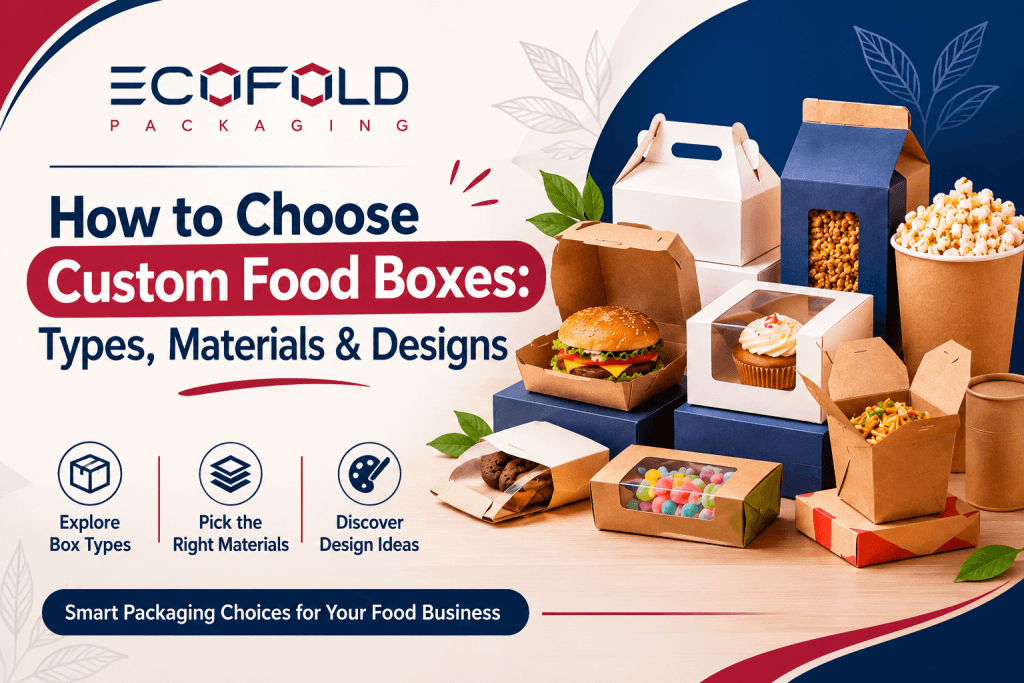
Choosing food packaging involves more than finding a box that looks good. The packaging needs to fit the product, protect it during handling, support the way it is sold, and communicate useful information to customers. A bakery may need a window box for pastries, while a snack brand may prefer a printed carton designed for retail shelves.
The right packaging starts with the product’s size, weight, temperature, moisture, grease content, and presentation requirements. Material selection and printing then affect how the finished box performs and looks.
This guide explains how to choose custom food boxes, compare packaging styles, select suitable materials, understand food-contact compliance, plan your design and artwork, and avoid common mistakes. Whether you run a bakery, restaurant, cafe, or packaged food brand, it will help you make a more informed decision.
What Are Custom Food Boxes?
Custom food boxes are packaging made to suit a particular food product, brand, and use. Unlike standard stock boxes, custom packaging is developed around specific dimensions, structural styles, printing requirements, and presentation needs.
A custom food box may include:
- Dimensions suited to the product.
- A suitable paperboard or corrugated structure.
- Printed logos and brand colors.
- Product information and labeling panels.
- Windows, inserts, or dividers where appropriate.
- Finishes selected for the intended application.
For example, a cupcake box needs an insert to keep cupcakes from moving, while a cereal carton needs space for product information and a suitable inner package.
The goal is to choose packaging that works for the food and for the way customers receive it. If you want to compare styles for retail products, bakery items, snacks, and takeaway food, you can browse our custom food boxes.
Different Types of Custom Food Boxes
Food businesses use different box structures depending on the product, serving format, and sales channel. Here are the most common options and where they fit.
1. Bakery and Pastry Boxes
Bakery packaging is used for cakes, cupcakes, cookies, pastries, and other baked goods. The right design depends on the product’s size, decoration, and handling requirements.
Common options include:
- Window bakery boxes for product visibility.
- Cupcake boxes with inserts.
- Cake boxes with enough height and support.
- Cookie boxes for retail or gift presentation.
- Kraft bakery boxes for a natural paper look.
A window helps customers see the product, but the box needs enough clearance so the lid or window never touches delicate decorations. For more options, see our custom bakery boxes.
Window film is usually a plastic such as PET or PLA, which can affect recyclability. Ask which film is used and whether it needs to be removed before the carton is recycled.
2. Burger and Takeout Boxes
Takeout packaging has to handle food portions, carrying, and delivery conditions. Mini burger boxes, Chinese takeout boxes, and noodle boxes are structures designed around different serving formats. For pizza, see our custom pizza boxes.
When choosing takeout packaging, consider:
- How the food fits inside the box.
- Whether grease or moisture will affect the material.
- How the box closes.
- Whether it can be carried or stacked.
- Whether ventilation is needed to manage steam.
- How the packaging will be handled during delivery.
A box that works for a dry snack is not automatically suitable for a hot, oily meal.
3. Cereal and Retail Food Cartons
Retail cartons are common for cereal, snacks, dry foods, and other packaged products. They give you space for branding and required information such as ingredients, nutrition details, and allergen statements.
Typical options include:
- Straight-tuck and reverse-tuck cartons.
- Printed cereal boxes.
- Sleeve packaging.
- Retail display cartons.
For retail products, artwork layout matters because customers look at the front, sides, and back panels before buying.
Packaged food labels in the US generally need a statement of identity, net quantity, ingredient list, allergen declaration, the name and place of business, and a Nutrition Facts panel unless an exemption applies. The allergen declaration must cover the nine major allergens, including sesame. Check the FDA labeling rules or ask a regulatory consultant before you finalize artwork.
4. Snack and Candy Boxes
Snack and candy packaging can be designed for retail display, gifting, or distribution. Examples include snack boxes, candy boxes, chocolate boxes, macaron boxes, and cookie boxes.
Depending on the product, the box may need inserts, dividers, windows, or internal bags. For chocolates and delicate confectionery, design the box around the product’s shape and protection needs, not only its outer appearance.
5. Coffee and Specialty Food Boxes
Coffee boxes are used for retail presentation, gift sets, and specialty products. Consider the actual product format: a carton holding a sealed coffee bag has different requirements from a box holding cups or a gift assortment. Custom dimensions, printed branding, and suitable inserts keep products organized and presentable.
Which Box Is Best for Which Food?
Use this table as a starting point. The final choice should account for your product’s actual dimensions, weight, temperature, moisture, and handling conditions.
| Food product | Best box style | Common material | Key consideration |
|---|---|---|---|
| Cupcakes | Cupcake box with insert | Paperboard | Secure inserts and enough height |
| Cakes | Cake box | Paperboard or corrugated | Base support and decoration clearance |
| Cookies | Tuck-end or window carton | Paperboard or kraft | Grease resistance and visibility |
| Burgers | Foldable burger box | Paperboard | Grease, steam, and closure |
| Chinese takeout | Oyster pail or takeout carton | Paperboard | Leak resistance and food temperature |
| Cereal | Printed retail carton | Paperboard | Inner liner and product information |
| Candy | Small folding carton | Paperboard | Product arrangement and presentation |
| Macarons | Window box with divider | Paperboard | Separation and protection from movement |
| Coffee gift sets | Custom carton with insert | Paperboard or corrugated | Arrangement and weight support |
| Dry snacks | Printed tuck-end carton | Paperboard | Shelf presentation and inner packaging |
Practical tip: Pick the box structure first, then confirm the material and dimensions. This prevents choosing an attractive design that doesn’t work for the food inside.
How to Choose the Right Material for Food Packaging Boxes
Material is one of the most important decisions in packaging design. The best option depends on the food, the box construction, storage conditions, and intended use.
Paperboard
Paperboard is the most common choice for folding cartons, cereal boxes, snack cartons, candy boxes, and bakery packaging. The most common grade is SBS (solid bleached sulfate), a bright white board with a smooth surface that prints sharply and folds into many box styles. Board thickness is measured as caliper in points (1 pt = 0.001 inch). Small folding cartons commonly use roughly 16 to 24 pt, while heavier products need thicker board or corrugated. Ask your supplier for the exact caliper of the board, because it affects both strength and feel.
Kraft Paperboard
Kraft paperboard has a natural brown appearance and is popular with bakeries, cafes, and brands that prefer a paper-based look. It can be printed with logos and product information.
Keep in mind that the kraft look alone doesn’t make packaging food-safe, grease-resistant, or compostable. Those properties depend on the actual material and construction. Uncoated kraft is also porous, so it absorbs oil and moisture faster than coated white board. For oily foods it usually needs a liner, a barrier coating, or greaseproof paper inside.
Corrugated Board
Corrugated board has a fluted layer between liner sheets, which gives it more strength and cushioning than thinner cartons. It suits heavier food products, transport packaging, and any application that needs extra structural support. Thin E-flute (about 1/16 inch) suits bakery and retail boxes, while thicker B-flute resists crushing better in shipping cartons.
Grease-Resistant and Barrier Materials
Foods with oil, moisture, or sauces need a suitable coating, barrier, or packaging structure. Grease resistance and moisture resistance are separate properties, so a material that resists oil won’t automatically protect against moisture. Options without PFAS include polyethylene or PLA coatings, water-based barrier coatings, and loose greaseproof liners such as glassine or parchment-type paper. Each has trade-offs: plastic-based coatings can make a carton harder to recycle depending on local facilities, and liners add another component. Two standard lab tests help compare materials: TAPPI T 559 measures grease resistance and the Cobb test (TAPPI T 441) measures water absorption. Ask suppliers for results on the board you are considering, and confirm that the complete construction suits your product and conditions of use.
What Makes Food Packaging Suitable for Different Products?
No single box works for every food. Choose packaging based on the conditions it will face.
- Dry foods: Dry snacks, cereal, and some confectionery usually work with a paperboard carton as outer packaging. If the product needs protection from moisture, oxygen, or contamination, add an appropriate inner package or barrier.
- Greasy foods: Fried foods, pastries, and oily snacks transfer grease to packaging. Pick a material and coating that match the product’s oil content and contact time, and test samples or review supplier documentation before a large order.
- Hot foods: Hot food produces steam and condensation. Account for ventilation, moisture, temperature, and how long the food sits before it is eaten. Trapped steam condenses, softens paperboard, and turns crisp food soggy, so vents or a small lid gap often matter as much as the board itself. A fully sealed box isn’t right for every hot food.
- Delicate products: Cupcakes, macarons, chocolates, and decorated cakes need inserts or dividers when movement could damage them.
PFAS and Food-Contact Compliance in the USA
PFAS are chemicals known for resisting grease, oil, and water. They were historically used in some grease-resistant paper food packaging.
The U.S. Food and Drug Administration announced in February 2024 that PFAS-containing grease-proofing substances were no longer being sold for food-contact use in the U.S. market, and in January 2025 it determined that 35 related food-contact notifications were no longer effective. You can read the details on the FDA’s PFAS market phase-out page.
State rules add another layer. Several states, including California, Maine, Minnesota, and Washington, restrict PFAS in food packaging, and requirements differ by state and application. Check the current rules for the states where you sell.
Wording matters here. Many state laws restrict intentionally added PFAS rather than requiring zero PFAS, and trace amounts can still enter through recycled fiber or manufacturing. Ask your supplier for the exact wording of its statement and any third-party test results, and avoid calling your own packaging PFAS-free unless you have documentation to back it up.
What to ask your packaging supplier
Before approving food packaging, ask for:
- A food-contact compliance statement for your intended application.
- Confirmation of whether the package is designed for direct food contact.
- Information on material and coating suitability.
- Documentation supporting any food-contact claims.
- Confirmation about intentionally added PFAS, where applicable.
A simple question that covers most of this:
“Can you provide a food-contact compliance statement confirming that this packaging construction is suitable for my product and intended conditions of use?”
A reputable supplier should be able to name the rule behind its answer. Paper and paperboard components that touch food fall under the FDA’s indirect food additive regulations in 21 CFR, with section 176.170 covering contact with aqueous and fatty foods and section 176.180 covering dry foods. Inks and adhesives need their own review, which is one reason printing is usually kept on the outside of the carton unless the supplier confirms the inks suit the intended contact.
Food-contact suitability depends on the whole construction, including the paperboard, coatings, inks, and adhesives. For more background, see the FDA’s guidance on food packaging and food-contact substances.
Custom Food Box Design, Printing, and Branding
Packaging is also a communication surface. A well-planned design helps customers recognize your product and understand what’s inside.
Common customization options include:
- Logo printing and brand colors.
- Product names and photography.
- Ingredient and nutrition panels.
- QR codes and promotional messages.
- Window cutouts.
- Matte or gloss finishes.
Design Ideas That Work for Food Packaging
Good food packaging design is clear first and decorative second. These approaches work across most food categories:
- Lead with a clear front panel. Put the logo, product name, and flavor or variant where a shopper looks first, and move ingredients, nutrition facts, and barcodes to the back or side panels.
- Use a window with purpose. Place the cutout where the best-looking part of the product shows, and make sure the product sits snugly behind it so it does not shift.
- Match the design to the material. A one- or two-color design suits uncoated kraft, while full-color photography and gradients print best on smooth white SBS board.
- Color-code variants. Keep one layout and change the color or illustration for each flavor, so a range looks consistent and customers can find their favorite quickly.
- Make inserts part of the design. Dividers and trays for macarons, chocolates, or cupcakes keep products in place and make the first look inside the box feel deliberate.
- Check readability at actual size. Print a proof at 100% and confirm that small text, such as ingredients and allergen statements, is legible against its background.
Choose the Right Printing Method
The right method depends on the artwork, quantity, material, and structure. Digital printing suits shorter runs and designs that change often. Offset printing is common for printed paperboard cartons, and flexographic printing is frequently used for corrugated packaging and larger runs.
Before production, review the artwork carefully and check:
- Logo placement and text readability.
- Color specifications.
- Bleed and safe areas.
- Panel orientation.
- Barcode placement.
- Required product information.
If your artwork isn’t ready, our free design support can help you prepare it. Our Packaging Die-Line Guide explains how to set up files correctly, and Packaging Colors That Sell covers how ink behaves on different materials.
Colors can shift between screen and paper. For brand-critical colors, ask for a physical proof or Pantone references, and remember that uncoated kraft absorbs ink and looks darker and duller than coated white board.
How Small Businesses Can Order Custom Food Boxes
Ordering is much easier when you prepare your requirements before asking for a quote. Our minimum order quantity starts at 100 units, so smaller businesses and new product launches can order custom packaging without committing to very large runs. If you are ordering for the first time, our beginner’s guide to packaging MOQ explains how minimum order quantities work.
Step 1: Identify the Product
Start with the food itself. Is it dry, oily, hot, cold, delicate, or moisture-sensitive?
Step 2: Measure the Product
Measure it in its packed condition, including space for inserts, closures, and inner packaging. Confirm whether your dimensions refer to the inside or outside of the box. Box sizes are normally written as length × width × height, measured inside. As a rule of thumb, leave a few millimeters (about 1/8 inch) of clearance per side, then confirm the fit with a physical sample.
Step 3: Choose the Box Style
Select a structure that fits the product and how it will be handled. A window carton, tuck-end box, takeout box, and corrugated tray box each serve a different purpose.
Step 4: Confirm the Material
Discuss product conditions with your supplier and confirm material suitability, food-contact requirements, and any barrier needs.
Step 5: Prepare the Artwork
Gather your logo, colors, and product information. If the artwork isn’t ready, ask about design assistance.
Step 6: Review the Digital Proof
Before production, check dimensions, material, printing, and the digital proof. Small errors are easy to fix at this stage and much harder to fix afterward.
Step 7: Confirm Production and Delivery
Confirm the timeline, shipping details, and quantity. Production typically takes 8 to 10 days after artwork approval for applicable orders, but confirm the schedule for your specific structure and destination.
Test Your Packaging Before a Full Order
A physical sample tells you more than any spec sheet. Ask for a sample or prototype, pack your real product in it, and run these checks:
- Fit test: Pack the food with its inserts and wrapping. Check clearance, closure, and whether the lid touches decorations or toppings.
- Grease and moisture test: Pack the food at its normal serving temperature and leave it for as long as it will sit in the box, such as 30 to 60 minutes for dine-in or longer for delivery. Check the outside and base for oil spots, softening, or leaks.
- Transit test: Carry or ship a few packed boxes, including stacking and jostling, then open them and look for movement or crushing.
- Shelf test: For retail cartons, stand the box on a shelf, check that the front panel reads clearly, and confirm the barcode scans.
Note the results and photograph any problems. They make it easy to compare materials or suppliers and to explain exactly what you need changed.
Common Food Packaging Mistakes to Avoid
- Choosing packaging only for its looks. A good-looking box may not protect the food. Check performance before finalizing the design.
- Ignoring grease and moisture. Oil and moisture affect paper-based packaging, so confirm the material or barrier suits the product.
- Using incorrect dimensions. A box that’s too small can damage the product, and one that’s too large lets it move around. Accurate measurements prevent both problems.
- Overlooking product information. Retail food packaging may need ingredients, nutrition facts, allergen declarations, or other labeling depending on the product and regulations. Confirm what’s required before approving artwork.
- Skipping the artwork review. Mistakes in text, colors, or panel placement cause problems once production starts.
- Making unsupported sustainability claims. Words like recyclable, compostable, biodegradable, and food-safe should only be used when they accurately describe the packaging. If sustainability matters to your brand, read our guide to sustainable packaging for small businesses or browse our eco-friendly boxes.
Frequently Asked Questions About Custom Food Boxes
What types of custom food boxes are available?
Common options include bakery boxes, cupcake boxes, cereal cartons, snack boxes, candy boxes, Chinese takeout boxes, noodle boxes, coffee boxes, and other custom food packaging styles.
Can custom food boxes include my company logo?
Yes. Custom food boxes can carry your logo, brand colors, product names, and other artwork. Printing options depend on the material, box structure, and order requirements.
Which material is best for custom food boxes?
It depends on the food, its temperature, moisture and grease content, the box structure, and how it will be used. Paperboard, kraft, and corrugated materials each suit different applications.
Are custom printed food boxes food-safe?
Food safety depends on the complete packaging construction and conditions of use. Confirm that the material, coatings, inks, and adhesives are suitable for your intended food-contact application.
How do I choose the correct size for food packaging?
Measure the product and allow for clearance, inserts, closures, and protection during handling. Confirm final dimensions with your supplier before production.
Are custom food boxes suitable for small businesses?
Yes, when the order quantity and production requirements fit your needs. With a minimum order of 100 units, small businesses can start with a manageable run.
Can I order custom food boxes in the USA?
Yes. EcoFold Packaging provides custom food boxes for businesses across the USA, based on your product dimensions, material preferences, artwork, and quantity.
Find the Right Custom Food Boxes for Your Product
The right food packaging starts with understanding what your product needs. Box dimensions, material, printing, and structure all work together to create packaging that serves both your business and your customers.
Whether you’re packaging baked goods, snacks, candy, cereal, coffee, or takeout meals, choosing the right structure and material early helps you avoid packaging problems later.
Ready to plan your custom food boxes packaging? Explore EcoFold’s custom food boxes to compare styles and design options, then share your product type, dimensions, quantity, and artwork status to get a quote.