
Guides
Your Candle Packaging Can Look Good and Still Fail
By Ahmad Shoukat · July 10, 2026
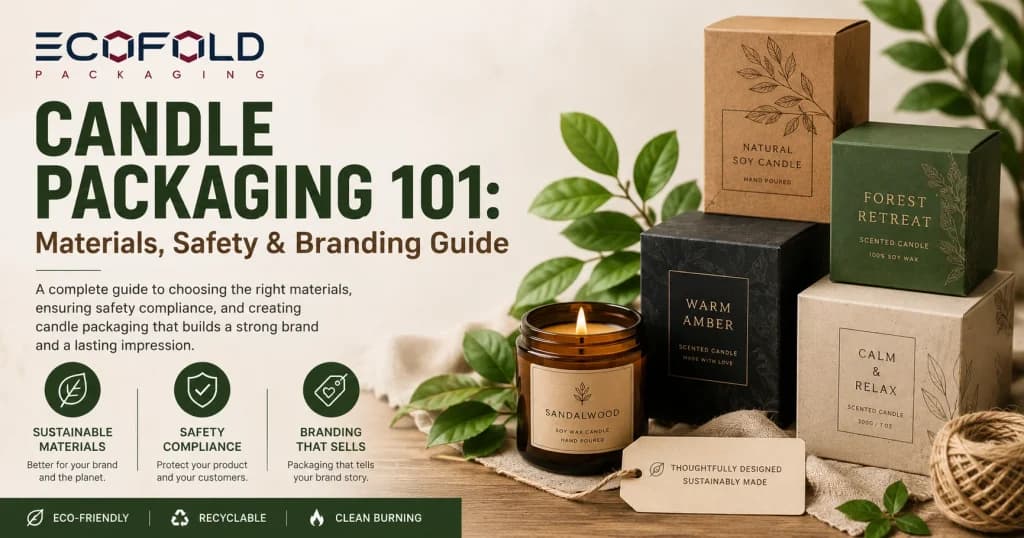
A beautifully printed candle box that arrives with the jar cracked inside is a failed package. So is a perfectly structured box with no room for the required safety warning text, or a kraft-wrapped candle where the box stands 2cm too tall because no one measured the lid.
Good candle packaging is a combination of the right material, the right internal dimensions, enough panel space for required information, and a design that matches the price point and brand of the product inside. All four have to be right. Most first-run candle packaging problems trace back to one of them.
Why Candle Packaging Needs More Than a Nice Design
The design is the last decision, not the first. Before artwork, a candle brand should have answered: what form is the candle in, a jar, a tin, a pillar, a votive? What does it weigh? How is it being sold, on a retail shelf, online, or in a gift program? Will it ship inside its own box or inside an outer corrugated box?
These are structural questions. A box that answers all of them correctly and prints well is doing its full job. A box that looks good but fails any of those points is an expensive reprint waiting to happen. Brands building their first candle packaging program can review structural formats and material options at our Custom Candle Boxes category.
Common Materials Used for Candle Packaging
Kraft paper is the default for natural, artisan, and soy candle brands. The unbleached brown surface communicates the brand positioning before any print is read. Kraft prints cleanly in 1 to 4 colors, takes foil stamping well, and keeps the natural look that most wellness-positioned candle brands want to project. An uncoated or aqueous-coated kraft board also keeps the recyclable claim intact — laminated kraft does not.
SBS white paperboard at 14pt to 16pt suits candle brands that need full-color CMYK print, gradient designs, or photography across the box exterior. The smooth surface holds fine detail and supports all standard finishes from matte to foil.
Rigid chipboard for luxury candle lines where the physical weight of the box is part of the brand experience. The most expensive material option but the appropriate choice for premium price points and high-end gifting formats.
For brands where the sustainability angle matters alongside the aesthetic, our guide on What Makes Packaging Truly Eco-Friendly explains what actually affects a material’s environmental credentials beyond how it looks.
Safety Details Every Candle Brand Should Plan For
Candles are a fire product. The packaging is where that information lives, and it needs legible panel space.
Most candle brands include the following on the box or an applied label: burn time, wax type and composition, fragrance name, net weight, safety warning instructions (never leave unattended, keep away from children and pets, trim the wick before each burn), and the manufacturer name and contact details.
Some brands also include fragrance allergen disclosures and country of manufacture. The exact requirements depend on the brand’s legal setup and the markets where the product is sold. Confirm specifics with a compliance advisor, not a packaging supplier.
The practical packaging implication: plan the back and side panels for all required safety information before the front panel layout is finalized. A front panel that takes up 80 percent of the design budget leaves very little room for the text that has to be there. Custom Stickers and Labels can carry warning instructions, burn notes, and batch information as applied elements on the box base or side when carton panel space is limited.
Glass jar candles also need internal support to prevent the jar from shifting during transit. Custom Packaging Inserts in cardboard or foam hold the jar in position and prevent the glass from contacting the box walls during shipping.
Choosing the Right Box Style for Candles
Jar candles, the most common candle format, work well in tuck-end retail cartons or two-piece lid and base builds. Internal dimensions need to clear the jar height plus the lid clearance, not just the jar body.
Allow 2 to 4mm of clearance on each side and above the candle for a snug fit that prevents movement without restricting removal. A box sized to the jar alone, without the lid measurement, produces a box the candle cannot exit cleanly.
Pillar candles need taller, narrower formats. Wax melts and wide shallow votives need low-profile tray or clamshell builds. Gift candle sets and premium single candles move toward two-piece builds and rigid formats. Boxes With Lids in the lid-and-base construction are the standard for premium candle presentation at retail and for gifting programs where the reveal moment matters.
Branding Details That Make Candle Packaging Work
The scent name is the primary product identifier for most candle buyers. It needs its own visual hierarchy on the front panel, below the brand name and large enough to read from arm’s length on a retail shelf. A buyer standing in front of a candle display reads the scent name before they read anything else.
Color coding across a scent range is a useful system: a floral scent line in soft pink and green, a woodsy line in brown and cream, a citrus line in yellow and white. The color signals the scent before the name is read. This is particularly useful for multi-SKU candle lines displayed together on a shelf.
Luxury candle packaging typically uses matte or soft-touch lamination, foil stamping on the brand mark, and debossed or embossed typography to create a tactile surface that communicates quality at first contact. Custom Rigid Boxes for premium candle lines combine chipboard structure with printed wraps in these finishes for the best balance of protection and brand presentation.
Final Checklist Before Printing Candle Boxes
Before the artwork file goes to the supplier, confirm:
- Candle dimensions: jar or pillar height including the lid or wick, and the widest diameter
- Internal box dimensions with 2 to 4mm clearance on all sides above and around the candle
- Whether an insert is needed and its material — cardboard, foam, or molded pulp
- Panel space allocation for all required safety and product information
- Finish choice and its impact on recyclability if that is a brand claim
- Whether the box ships as a standalone package or inside a corrugated outer
- Final artwork review against the dieline before production is committed
Every item on that list can change the quote. Brands at the budgeting stage can review how each element — material, structure, insert, finish — affects pricing in our guide on Custom Packaging Cost in 2026 before finalizing a specification.
The Starting Point
A candle box packaging program that works is one that protects the product, carries all required safety information in a legible format, matches the brand, and survives the journey to the customer in the condition it was designed to deliver.
Get the structure and dimensions right first. Confirm the safety panel allocation. Then finalize the design. The best-looking candle box that was sized wrong, or that has no room for the warning text, still costs the same to reprint.
Frequently Asked Questions
What materials work best for candle packaging?
Kraft for natural and artisan brands, SBS white paperboard for full-color retail print, and rigid chipboard for luxury and gift formats. The right choice depends on the brand positioning and the price point of the candle.
What safety information should candle packaging include?
Most candle brands include burn time, wax type, fragrance name, net weight, warning instructions, and manufacturer contact details. Confirm requirements for your specific product and market with a legal or product safety advisor.
How should I measure a candle for its box?
Measure the candle height including the lid or cap, not just the jar body. Measure the widest diameter. Allow 2 to 4mm of clearance on each side and above the candle in the internal dimensions for a snug but easy fit.
Do candle boxes need inserts?
Glass jar candles typically need an insert to prevent the jar from shifting and contacting the box walls during shipping. Pillar candles and wax melts may need a different form of support depending on the box size and shipping method.
Which finish is best for candle boxes?
Matte lamination is the most common across premium and mid-tier candle brands. Soft-touch matte is popular for luxury formats. Avoid plastic lamination on kraft if recyclability is part of the brand message.