
Guides
Child-Resistant Cannabis Packaging: Requirements Explained
By editoruser · July 30, 2026
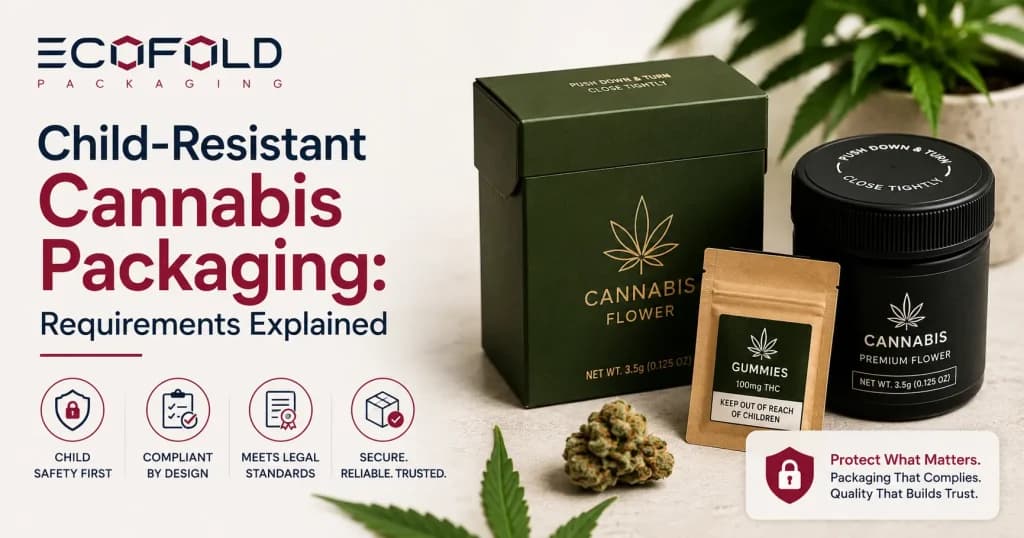
Note: This article is for educational purposes only and is not legal or compliance advice. Requirements vary by state, product type, and regulatory framework. Always consult a compliance professional or your state regulator for guidance specific to your products and markets.
Child-resistant does not mean impossible to open. It means that fewer than 20 percent of children aged 42 to 51 months can open the packaging within five minutes under controlled laboratory test conditions. That precise, technical definition is what separates genuinely compliant cannabis packaging from packaging that simply feels secure.
For cannabis brands, child-resistant cannabis packaging is not optional in any US legal market. This article explains the federal standards, testing protocols, and state-level regulations that govern what counts as compliant, and what commonly causes brands to fall short of the requirements.
The Federal Foundation: PPPA and CPSC
The Poison Prevention Packaging Act (PPPA), enacted in 1970, established the federal framework for child-resistant packaging in the United States. It is administered by the Consumer Product Safety Commission (CPSC) and sets the baseline performance requirements that all covered products must meet.
Under CPSC regulations at 16 CFR Part 1700, child-resistant packaging must pass standardized testing with two groups of participants. The child panel consists of 200 children between the ages of 42 and 51 months.
At least 80 percent of those children must be unable to open the packaging within the test timeframe. The adult panel consists of 100 adults aged 18 to 70, of whom at least 90 percent must be able to open and properly reclose the packaging after a demonstration.
Both thresholds must be met. A package that resists children but cannot be opened by seniors does not pass the standard. Cannabis is not explicitly named in the original PPPA because most cannabis products existed outside legal commerce when the law was written. State cannabis regulations apply the PPPA baseline to cannabis products and add requirements beyond it.
ASTM Standards Specific to Cannabis Packaging
Two ASTM International standards are particularly relevant for brands navigating cannabis packaging requirements.
ASTM D3475 is the foundational Standard Classification of Child-Resistant Packages. It establishes testing protocols and classification criteria across product categories and is the parent standard that state cannabis regulators frequently reference when setting packaging requirements.
ASTM D8441 (also referenced as ASTM D8441/D8441M) is a newer standard developed specifically for intoxicating cannabinoid products. Several states have incorporated this standard into their cannabis regulations.
It addresses child-resistant packaging performance alongside the universal cannabis warning symbol and label element requirements. Brands operating across multiple state markets should confirm which ASTM standards each state has incorporated by reference.
Information on cannabis packaging formats and carton structures that support these compliance requirements is available in our Cannabis Packaging category.
Single-Use vs. Reclosable Child-Resistant Packaging
This is the distinction most frequently misunderstood in child-resistant packaging for cannabis compliance programs, and it is one of the most consequential.
Single-use child-resistant packaging must be resistant to opening only at first access. Once opened, it is not required to maintain child-resistant properties. This is the appropriate specification for products consumed entirely in a single use, such as a single-serving edible or an individual pre-roll.
Reclosable child-resistant packaging must maintain its child-resistant performance every time it is opened and reclosed. This is the required specification for multi-serving products, including most cannabis edible formats, multi-pack pre-rolls, and any product a consumer opens multiple times before fully consuming the contents.
A package that is difficult to open initially but easy to reopen after the first use does not satisfy the reclosable CR requirement, even if it passed initial certification. Most regulated US cannabis markets require reclosable child-resistant packaging for multi-serving edible products.
How Child-Resistant Testing Actually Works
Packaging manufacturers who claim their packaging meets child-resistant standards must have it tested by a CPSC-recognized accredited third-party testing laboratory. Self-certification is not acceptable.
The standard CPSC protocol test runs in two phases with the child panel. In the first phase, children attempt to open the packaging without assistance for up to five minutes. In the second phase, they receive a demonstration of how to open the packaging and then get another five-minute attempt. The child panel must fail both phases at the required threshold for the packaging to pass.
The adult panel is tested separately on both the ability to open the packaging and the ability to properly reclose it. Passing both the child and adult thresholds is required for CR certification.
The testing laboratory produces a certification report documenting the results, and brands should keep that documentation on file. State regulators may request evidence of certification during inspections or license renewals.
State Cannabis Regulations Layer Additional Requirements
Federal PPPA requirements set the floor. State cannabis regulations build additional requirements on top, and those requirements differ meaningfully between states.
Most US legal cannabis markets require child-resistant packaging for all cannabis products at the point of sale. Many states also require:
- Opaque packaging that prevents the product from being seen through the exterior
- Reclosable child-resistant closure for multi-serving products
- A universal cannabis or intoxicating cannabinoid warning symbol at a minimum printed size
- State-specific warning language and placement on every retail unit
- Tamper-evident features on certain product categories
The requirements in California, Colorado, Illinois, New York, and Michigan, among others, each have distinct details. Compliance in one state does not guarantee compliance in another.
Brands that also carry hemp-derived CBD products alongside their cannabis line should note that CBD products face different regulatory frameworks. Our CBD Packaging category covers the separate packaging considerations that apply to hemp-derived products.
Materials Used in Child-Resistant Cannabis Packaging
The mechanical properties required to pass CR testing influence which materials and closure designs work. Common formats include:
Flexible pouches with CR zipper or push-lock seals. Common for flower, pre-rolls, and edibles. These can be printed with full brand and compliance information.
Rigid cartons with press-tab or push-and-slide locking mechanisms. These require a specific fold and tab configuration that children cannot easily manipulate. They are paper-based, printable, and often used for edible and concentrate cartons.
Glass or rigid plastic bottles with push-and-turn caps. Standard for tinctures, oils, and liquid cannabis products.
Blister packs with foil backing. Appropriate for single-serve applications only since they cannot be resealed after opening.
For brands evaluating packaging materials that combine child-resistant compliance with sustainable credentials, our guide on What Makes Packaging Truly Eco-Friendly explains which material and finish choices support recyclability claims and which do not.
Common Causes of Non-Compliance
Several avoidable decisions lead to cannabis packaging regulations failures:
Using certification from one product category on a different product. CR certification is product-specific. A certification obtained for dry cannabis flower may not apply to a liquid tincture or a multi-serving edible.
Modifying packaging after certification. Any change to the closure mechanism, material thickness, or seal configuration may invalidate the original test results. Modified packaging should be retested before being placed into distribution.
Assuming one state’s approval transfers to another. State cannabis packaging regulations are not harmonized. A format approved in Colorado may not satisfy New York’s requirements.
Cannabis brands that also build a retail counter display program alongside compliant inner packaging can find shelf-ready carton options in our Custom Retail Boxes range.
How Brands Can Verify Their Packaging Is Compliant
The steps that consistently reduce compliance risk in child-resistant cannabis packaging programs:
- Work only with packaging suppliers who provide third-party CR testing certification documentation for the specific formats they supply. Supplier claims of compliance without documentation are not sufficient.
- Confirm state-specific requirements with a cannabis packaging attorney or state regulator before finalizing specifications for each new market entry.
- Re-verify certification after any supplier change, material change, or closure design modification.
- Keep all certification documentation on file and accessible. State inspectors may request it.
- Build compliance review into the artwork approval process, not as a separate step after design is finalized.
Brands building a full paper-based packaging program that includes compliant CR carton options can explore our Custom Eco Friendly Boxes range, which includes kraft and recyclable paper-based carton formats compatible with press-tab locking mechanisms for child-resistant applications.
Frequently Asked Questions
What is child-resistant cannabis packaging?
Child-resistant cannabis packaging is packaging that passes CPSC-recognized testing confirming that at least 80 percent of children aged 42 to 51 months cannot open it within five minutes, while at least 90 percent of adults aged 18 to 70 can open and reclose it.
Why is child-resistant packaging required for cannabis products?
To prevent accidental ingestion by children. Cannabis products can cause serious harm to children who access them accidentally. Every US legal cannabis market requires child-resistant packaging to reduce this risk.
Which regulations govern cannabis packaging in the United States?
The federal Poison Prevention Packaging Act (PPPA), enforced by the CPSC, establishes the baseline standards. Individual state cannabis regulations layer additional product-specific requirements on top of the federal framework.
What materials are commonly used for child-resistant cannabis packaging?
Flexible pouches with CR zip seals, rigid cartons with press-tab locking mechanisms, glass or plastic bottles with push-and-turn caps, and blister packs for single-serving applications.
How can businesses ensure cannabis packaging compliance?
By sourcing packaging from suppliers who provide documented third-party CR certification, verifying state-specific requirements before entering each new market, retesting after any packaging design change, and keeping all certification records on file.